

Rethinking content strategy for an unfamiliar destination
Strategic Question
What if getting discovered is only part of the content problem?
For an emerging tourism destination, people may find you and still not feel ready to choose you. That is the problem I kept coming back to while thinking about Bangladesh as a destination for international travelers.
If someone is considering Thailand, Italy, or Japan, they probably already have some idea of what the trip might look like. Content can help them choose a city, plan an itinerary, or decide who to book with.
Bangladesh is different.
Many international travelers do not have a clear picture of Bangladesh as a leisure destination. Some may know very little about it beyond the things they have seen in international news or general media. A tourism brand cannot simply assume Bangladesh is already on their list.
My first thought was destination storytelling. Show the landscapes, history, and experiences that travelers rarely associate with the country.
I still think that matters. But I started to see a gap in that thinking.
A good story may make someone curious. Curiosity does not mean they are ready to travel.
So the question became:
What is stopping an interested traveler from feeling ready to choose Bangladesh?
Business Context
For a tourism brand like Bangladesh Explore, clicks matter. But the business ultimately needs bookings.
The obvious route would be to publish more destination content and target more travel searches. There is a reasonable argument for doing exactly that.
More content can mean broader keyword coverage and more traffic. For a growing website, the numbers also make progress easier to show.
My concern is what those numbers might hide.
If traffic grows, but most visitors were never likely to consider Bangladesh, have we really solved the business problem?
I would rather narrow the audience.
The travelers I see as a better fit are people from established outbound tourism markets who actively look for natural and historical diversity. They are open to destinations outside the usual travel circuit and may even enjoy some of the unfamiliarity that comes with them.
Photographers and travel creators also make sense here. A less documented landscape gives them something different to explore and show.
Of course, being adventurous does not make someone careless about money or logistics. The trip still has to feel worth the cost, time, and effort.
This is where my view of the content problem changed. I became less interested in maximum reach and more interested in whether the right traveler was becoming more confident about the destination.
Reframing the Problem
A traffic-focused approach would ask:
How do we attract more travel traffic?
I think I would ask:
What questions are keeping an interested traveler from choosing Bangladesh?
The difference may look small, but it changes what gets published.
A keyword can bring someone to the website without addressing the reason they are hesitant. Meanwhile, a smaller group of travelers may be far more valuable if the content helps them understand the trip before they speak to the business.
I do not think this problem is limited to tourism.
An unfamiliar product or a new category can get plenty of attention while people are still unsure what it means for them. They may like the idea but not understand the experience, the effort involved, or the risk of making the wrong choice.
At that point, I think content has to be clear about the problem it is solving.
Do we need more people to see us?
Or do the interested people need more help deciding?
For Bangladesh Explore, I would focus on the second problem.
Strategic Decision 1: Start With Traveler Desire, Not a List of Destinations
I would not try to give every destination in Bangladesh the same content priority.
That may create a complete travel website, but completeness is not necessarily relevance.
I would start by looking at what the intended traveler already finds exciting and where Bangladesh can genuinely meet that interest.
The Sundarbans is an obvious example.
It is important within Bangladesh, but that alone is not why I would prioritize it. It offers nature, wildlife, remoteness, an unusual landscape, and a sense of adventure. Those are already close to the motivations of the traveler I want to reach.
So instead of asking only, Which destinations need content?, I would ask:
Which parts of Bangladesh give this traveler a reason to care?
There is a weakness in this approach, and I think it is important to admit it.
It will not fix Bangladesh’s overall image as a travel destination.
The strategy is not trying to convince every international traveler that Bangladesh should be their next holiday. It starts with people who already have some interest in adventure, nature, history, or less conventional places.
That is a smaller group.
But trying to change the perception of an entire travel market through one tourism brand feels too broad to me. I would rather begin where a genuine connection between traveler interest and the destination already exists.
Strategic Decision 2: The Unfamiliar Is Part of the Appeal—and Part of the Problem
The Sundarbans is interesting because the same thing that attracts a traveler can also make them hesitate.
A remote mangrove environment sounds unusual. That is part of the appeal.
But what does staying there actually feel like? How does the trip work? What is the environment like? Will the experience be comfortable enough?
These are very practical questions, but they affect the emotional decision too. If I cannot picture myself taking a trip, it is difficult for me to seriously consider booking it.
That means destination content cannot stop at inspiration.
Information about stays, itineraries, the local environment, and the character of the place should each help remove a particular uncertainty.
I would not add these details just to make an article longer or more “comprehensive.” I would want to know what question each piece of information is answering.
This idea also travels beyond tourism.
When something is unfamiliar, people often need help understanding the experience before they can evaluate the offer. In that situation, education is already doing part of the conversion work.
The goal is not to explain everything.
It is to find the questions that are keeping an interested person from moving forward.
Strategic Decision 3: Do Not Ask for the Booking Too Early
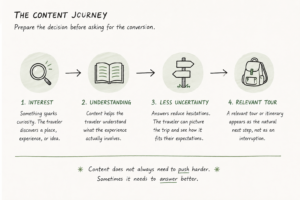
I would connect destination content with relevant tours, but I would be careful about how that connection feels.
Not every article needs to turn into a sales pitch.
If a traveler is still trying to understand the experience, a louder call to action probably does not solve the problem. They may simply need another question answered.
The tour should appear when it makes sense as the next step.
For example, once someone understands what a Sundarbans experience involves, seeing a relevant itinerary feels useful. It gives the reader an option to explore the trip in a more concrete way.
The journey I have in mind is simple:
Interest → understanding → less uncertainty → relevant tour
This may send fewer people aggressively towards commercial pages.
I am comfortable with that trade-off.
I would rather have a traveler enter a booking conversation with some idea of the region or experience they want than arrive with a vague interest in visiting Bangladesh.
Business Impact I Would Look For
I would still watch impressions, clicks, and organic visibility. If the content cannot be found, the rest of the strategy has very little room to work.
But I would also listen closely to the booking conversations.
Are travelers arriving with a clearer picture of Bangladesh?
Do they talk about Chittagong for its mountains and sea?
Do they mention Barisal because they are interested in rivers?
Do they already know which part of the country they want to explore?
I find the difference between two questions important.
One traveler asks:
What is there to do in Bangladesh?
Another says:
I want to explore the rivers around Barisal.
The second person has already made several small decisions before starting the conversation.
That is where I would look for the effect of the content.
It may not always appear as a direct conversion in a dashboard. Sometimes content has already explained the basics, removed an early concern, or helped the prospect form a preference.
The next conversation becomes easier because it does not have to start from zero.
I would treat that as a business signal.
Strategic Reflection
If I were starting again, I would try to understand the hesitation earlier.
There is an uncomfortable weakness in the approach I have described: it still begins with assumptions about the traveler.
They may be sensible assumptions. But the brand is still deciding what it thinks people are worried about.
I would want more evidence.
I would look at the questions travelers ask when a tourism brand is not guiding the conversation. Reddit and other open communities are useful for that reason.
People speak differently in those spaces. They compare destinations, ask questions they may consider too basic elsewhere, repeat misconceptions, and openly say what makes them uncomfortable.
That could tell me where the real decision friction is before I decide what the editorial system should prioritize.
I also think this matters more as AI becomes part of travel research.
People are increasingly able to explore a destination by asking detailed questions rather than moving through a brand’s website page by page. The information surrounding a destination—across websites, discussions, and other public sources—helps shape what can be understood about it.
So I would not think about community conversations only as another place to publish content.
I would use them to listen first.
And I would pay attention to how the destination is being explained outside the brand’s own website.
My thinking on this problem has changed in a fairly simple way.
I started with:
How do we tell better stories about Bangladesh?
Then I asked:
What is stopping an interested traveler from choosing?
Now I would ask:
Where can I see evidence of that hesitation before deciding which stories to tell?
That is the shift I would carry into another business problem.
Principles Taken Forward
Discoverability means very little if the people finding you were never likely to consider what you offer.
In an unfamiliar market, attention and readiness can grow at very different speeds.
Content priorities should begin where audience interest and the reality of the offer meet.
A strategy does not have to solve the whole market problem to be commercially useful.
Sometimes the thing that makes an offer interesting is also the thing that makes people hesitate.
When uncertainty is stopping a decision, practical information is not “extra content.” It is part of the strategy.
A stronger call to action cannot answer a question the audience is still struggling with.
And content may have done its job before the conversion happens. Sometimes the evidence is that the next conversation no longer has to start from zero.
The question I would carry forward is:
What is the audience still unable to decide—and why?